




SAMAYA X GMHM
“BY THE FORCE OF THE WIND”: CROSSING THE PATAGONIAN ICE CAP BY THE GMHM

45 days of immersion and bivouac in some of the most extreme conditions. Total autonomy. From October 30 to December 13, 2022, Didier Jourdain, Léo Billon, Jordi Noguere, Thomas Auvaro and Christophe Malangé, from the High Mountain Military Group (GMHM), are embarking on an expedition to Patagonia, in order to connect Lake Leones from Hielo North to the Gray glacier of southern Hielo.
The north-south crossing of the Patagonian ice cap, in total autonomy, seems to meet all the conditions for the GMHM to carry out an expedition there: remote, inhospitable, inaccessible zone and suffering from the most extreme weather conditions, making air rescue and l evacuation almost impossible. Captain Didier Jourdain summarizes: “ we are simply going to look for complexity ”.
The GMHM, aware of the conditions and risks associated with this expedition, began an intense and meticulous preparation, lasting two years. Nothing should be left to chance and attention to detail is vital. “ There are some details that are actually not really trivial, but as important as they are simple. », in the words of Captain Didier Jourdain. Indeed, the expedition takes on a new complexity. First of all, because of its duration which requires thinking about the initial supply, given the self-sufficient nature of the expedition. Then, because of the terrain with more than 600 kilometers of glaciers to cross, by kayak, ski, kite, on foot by towing heavy 60-kilogram pulkas. Last but not least, because of the weather conditions, which test the human as much as the equipment.
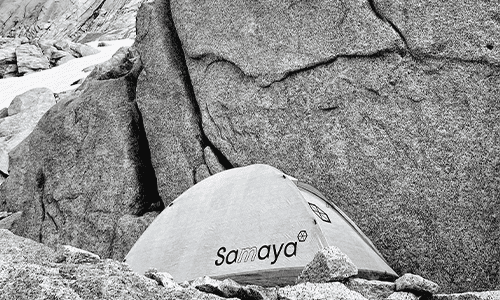
Equipment is therefore a problem in its own right. Captain Didier Jourdain explains it by the fact that you only need to bring “the essentials and the minimum” . This mantra sums up in itself the challenge of preparation. A perfect balance between weight and usefulness must be found for each object taken: “ something that has several uses, it does everything, but everything hurts. We are constantly confronted with this. We try to have equipment that is very versatile, but that is not necessarily efficient in all areas. […] We develop equipment, we make choices. ". It is in this perspective that a new Samaya tent is imagined, in consultation with the GMHM. This tent must be a perfect triptych combining performance, lightness and comfort.

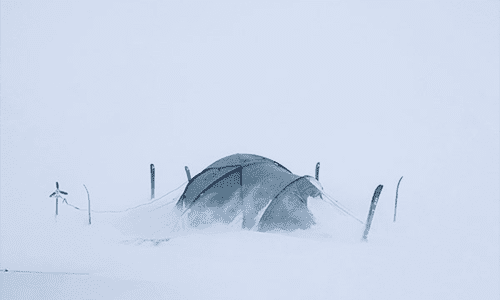
Performance first, insofar as the tent represents the only shelter, the only refuge protecting the members of the group from the destructive elements present outside. Captain Jourdain tells us: “ For the weather conditions, we can speak of the worst. The wind creates doubt, in everything. Especially in the choice of the tent. It's the most windy thing, clearly. […] It has to be the thing that holds. ". It must be able to hold its shape without sagging in the wind or under the weight of snow, be robust in all conditions and be easily set up and taken down, even in 80 km/h winds.
Lightness, then, the sine qua non of the expedition. 100 grams of extra tissue is equivalent to getting rid of 100 grams of food or gas. “ Sometimes we say to ourselves […] no, but there it doesn't make a big difference and then we weigh it and if, it makes the difference. sums up Captain Didier Jourdain. The lightness of the Nanovent® single-wall and Dyneema® materials is therefore essential. Weight will thus be a closely monitored criterion throughout the development of this new tent.
Comfort, finally, since beyond protecting, the tent must allow the group to rest, recharge and regain strength. It is imperative that the walls do not vibrate during windstorms, to ensure the rest of the group. Captain Didier Jourdain describes a moment when the group found themselves trapped in the heart of a storm, forced to retreat inside the tent. “The wind started to pick up, we finished setting up the tents and there was more than 80 km/h of established wind, gusts of more than 100, and driving rain. We finished, we were completely soaked. […] It's important to have a little bit of space in the tent. So there is also the environment in the tent and the place. In the morning, it was -10C°. ".

The notion of trust is essential. First, the members of the GMHM must have confidence in themselves, from an individual point of view, both in terms of their physical and psychological performance in supporting the conditions of the mission. Then, they must be able to count on their team despite the difficulties encountered. Finally, they must have confidence in their material. A seam or a thread that lacks strength can lead to the rupture of the tent, putting the whole group in danger. The tent is their only bulwark against outside conditions. Without it, the group finds itself exposed, vulnerable, unable to progress.
As early as 2021, the GMHM began a cycle of expeditions to Antarctica and Greenland, during which the Samaya tents created for them were tested in the field. These test phases made it possible to adjust the product so that it corresponded precisely to the needs of the group and to the reality on the ground. Confidence in the tent has only been obtained by virtue of the joint work of GMHM and Samaya, the assurance that the tent has technical characteristics in line with the weather conditions of the expedition, and because of the control of this equipment thanks to the tests carried out upstream.
The extreme conditions encountered during an expedition like this allow the GMHM to come back with operational methods and techniques that can be directly transposed to mountain commandos and then to the army. At the end of the mission, the group is also able to formulate material recommendations. This allows Samaya to progress on the technique in order to push the ultra-performance of its products ever further.
What is the GMHM?
The GMHM was formed in 1976, with the primary objective of promoting high-level mountaineering within the French army. This elite unit, numbering around ten people, brings together the best mountaineers and mountain guides from the civilian and military worlds. Its vocation has expanded over the years and today includes the exploration of inhospitable and polar areas and the training of mountain commandos and EMHM instructors in the Great Cold. The group guarantees the reinforcement of the operational competence of the Army, as well as the innovation of practices in extreme conditions, from a civilian and military perspective. In this context, they put to the test material and human techniques allowing to know, understand, apprehend and control the mountain, the verticality and the great cold.